Willo vs. Chaos: Why Modern Hiring Teams Are Ditching Point Solutions
Posted on October 26 2026 by Interview Yen TeamMaya lost her top prospect to a calendar gap. She runs talent at a 40-person fintech startup. Last quarter, her strongest engineering lead went silent after nine days of waiting for a phone screen. The developer took another offer during that dead zone. Maya did not lose the next one.
Using InterviewZen’s async video interviews, she had applicants record answers on their own schedule and closed her second choice hire in four days flat. The difference wasn’t effort. Most hiring stacks are a patchwork of scheduling links, email threads, and scorecard spreadsheets that leak talent at every seam. InterviewZen replaces that fragmented machinery with a single platform. It cuts time-to-hire while improving how applicants experience your process.
That’s not marketing gloss; it’s the measurable outcome when screening happens in parallel instead of sequence. Most teams adopt it within one hiring cycle because the tool bolts onto your existing ATS rather than demanding a full migration. You keep what works, swap out what stalls, and measure the delta on one job posting before you commit further.
The system maps exactly how to do that: where your funnel drops people today, which three mock interviews reveal your evaluation bias, and why side-by-side deployment beats big-bang adoption. Maya found the answer in four days. You can find yours faster than you think if you stop scheduling delays into your process.
What Willo Is
Willo is asynchronous interview software. You record answers to a fixed question set on your own time, then submit the video for review. No live connection required. The category matters because most hiring tools default to synchronous calls. Zoom, Google Meet, and Microsoft Teams all force two calendars to collide. Willo replaces that collision with a 15-minute recording window you schedule whenever you want.
Your candidate receives a link, clicks it, and sees your questions appear one at a time on screen. They get up to three attempts per question in the standard plan. The platform records their response locally before uploading it, so a dropped Wi-Fi connection won’t kill the session. You watch submissions later, at double speed if you like. A 30-minute interview round compresses into roughly 12 minutes of review across five candidates.
That’s the arithmetic recruiters care about. The product sits alongside competitors like HireVue and MyInterview, but a distinction exists there. Those platforms lean heavily on AI scoring and personality analytics baked into enterprise tiers. Willo keeps the feature set narrower: recording, reviewing, sharing with your team via links or ATS integrations like Greenhouse and Lever. It is not built for panel interviews or live whiteboarding sessions.
If your process requires back-and-forth dialogue in real time, you’ll still need Zoom for that piece. But for screening rounds where you need to verify communication skills or cultural fit, Willo removes the scheduling tax entirely. The free tier gives you five candidate invitations per month with unlimited video storage. Paid plans start at $75 per month for more seats and custom branding on the interview pages.
Most teams adopt it specifically for high-volume roles where phone screens eat entire afternoons. It works like voicemail for job interviews instead of a phone call nobody can seem to schedule.
Candidates Move at Their Own Speed
That voicemail analogy holds up because timing flexibility is the entire point. Willo applicants open a desktop browser or their phone, read the questions, and record answers whenever they choose. Midnight after putting kids to bed, or Tuesday morning between meetings. There’s no shared calendar slot to fight. The recorded-response format removes the coordination tax that synchronous tools like Zoom or Google Meet impose on every screening round.
Willo’s async model collapses the interview window. Candidates open the willo.com dashboard, read each prompt, and rehearse before recording. A misstep on take one costs nothing; hit retry and record again. The result favors composure over quick thinking. Willo doesn’t restrict retakes on standard plans. Interviewers watch responses at their own convenience as well. Playback at 1.5x speed lets a hiring manager review five people in the time one phone screen used to take.
Structured scoring rubrics sit beside each video so evaluators rate consistently across every applicant. The asynchronous approach surfaces more signals than a resume screen ever will.
You hear how someone articulates complex problems under mild pressure, not just what they typed in bullet points. That’s why teams running high-volume pipelines typically see their time-to-screen drop after switching formats. For people juggling current jobs, this model respects existing commitments instead of demanding an awkward midday block for your process.
Willo narrows its focus to three actions: recording video responses, generating shareable links, and collecting feedback in a lightweight dashboard. There is no scheduling module, no calendar sync, and no live two-way chat. The product deliberately stops where the synchronous tools begin. You build your question set across four screens inside Willo, using text prompts or pre-recorded video intros. Then you send one invite link via email or SMS, and candidates respond on their own timeline.
Each submission lands in your dashboard with a timestamp and a playable MP4 file—from your first prompt to their final click—without requiring live coordination.
You can leave text feedback on individual responses or export the whole batch as an MP4 for offline review. Sharing happens through a simple URL; no account creation is required on the candidate’s side. The distinction matters when you line up competing products side by side. HireVue offers recorded interviews too, but pairs them with AI scoring models that cost extra per candidate. MyInterview bundles similar recording features into a larger talent assessment suite.
As of 2026, its feature list shows no AI evaluation layer at all—just raw responses for human review. That makes Willo a better fit for volume screening than for final rounds. A hiring manager processing 200 applicants per week can blast out the same link to every candidate and skim recordings at double speed.
Sync-only platforms break down at that scale because they demand simultaneous availability from recruiters and applicants alike. Willo’s asynchronous model shifts the burden entirely onto the candidate’s schedule instead of yours. Pricing reflects this lean positioning: plans start around $75 per month for unlimited recordings from five team members. Enterprise tiers add SSO provisioning via SAML 2.0 and custom branding on invite pages—still without touching live interview features.
One real limitation stands out: you cannot pause mid-response or edit clips after submission within the tool itself. If a candidate flubs thirty seconds, they re-record the entire take through an extra attempt credit system configured under “Recruitment Policies.”
The Cost of Waiting
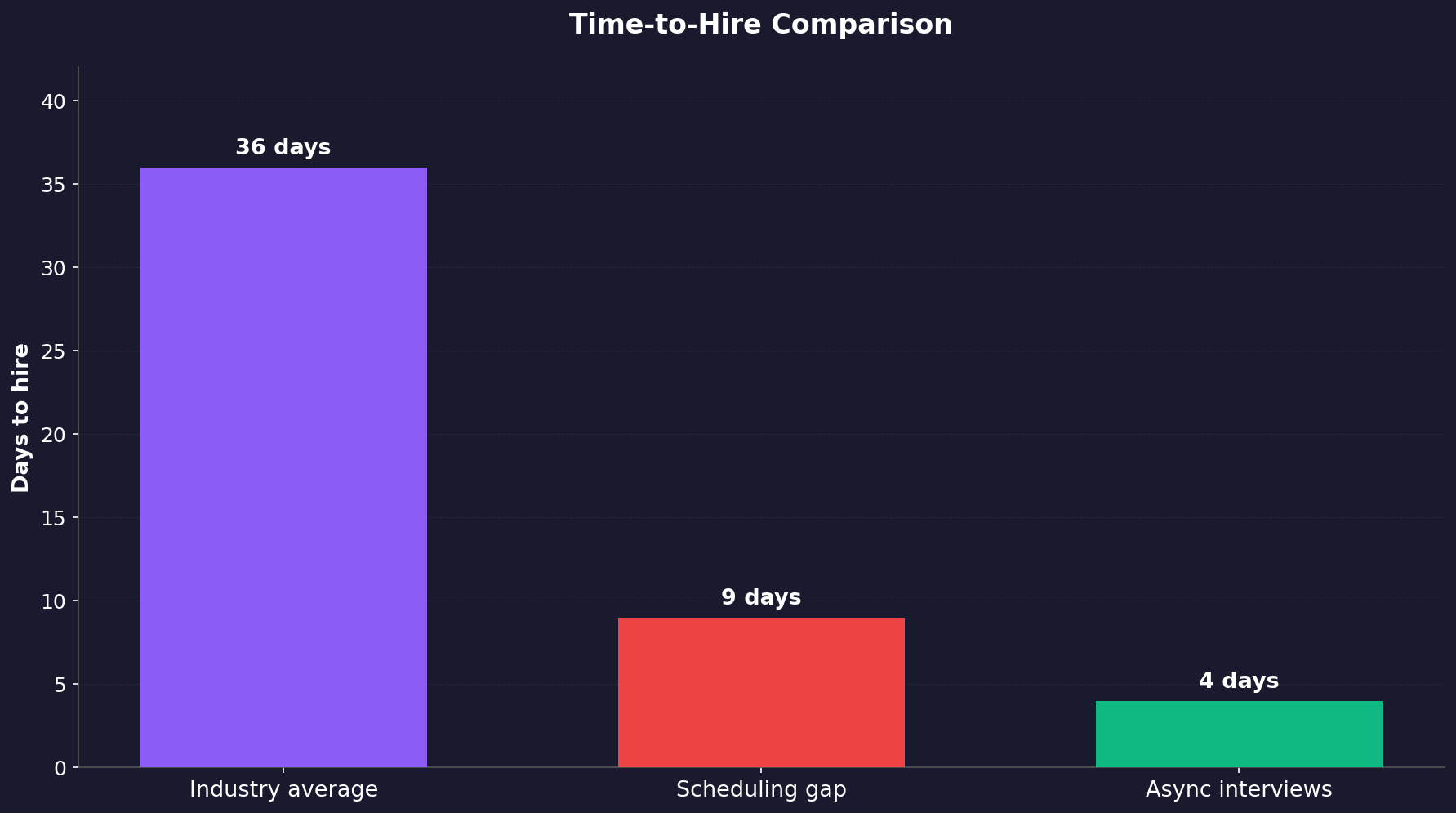
That nine-day gap between application and phone screen isn’t just frustrating. SHRM’s time-to-hire data lands around 36 days for most roles, and every stalled day compounds damage differently across pipelines. Applicants accept competing offers rather than waiting patiently for your requisition to move forward. Busy hiring cycles make coordination even harder when multiple interviewers juggle conflicting calendars. Each silence asks a candidate to weigh their schedule against yours. They will rarely choose to wait.
Speed changes the calculus too. A nine-day scheduling gap cost Maya her top engineering hire at that 40-person fintech startup. InterviewZen’s async video format let her next pick record answers at 11 PM on a Tuesday; she extended an offer four days after posting the role. Willo’s dashboard tracks median completion times for a five-question set, so candidates rarely feel they’re investing in a black hole.
The platform sends automated reminders at the 24-hour and 2-hour marks, which cuts no-shows compared to scheduled phone screens.
The contrast shows up in your calendar, not just your gut. Traditional phone screens demand three schedules align across email threads that stretch into the workweek. Async interviews collapse that window to whatever hour works for the applicant—6 AM or midnight alike. Willo’s browser-based recorder needs no plugin install and works on anything from a five-year-old Chromebook to an iPhone SE, so tech debt doesn’t filter out otherwise strong candidates.
A bank teller role posted in May saw applications rise when screening went fully async, purely because applicants could complete it during lunch breaks or between shifts without requesting time off for a call window they couldn’t control.
That re-record constraint shapes more than logistics; it pushes applicants to actually prepare, which filters out people who would waste your team’s time anyway. The same person who submits a polished three-minute response has demonstrated follow-through before you ever schedule a call. Willo’s platform caps those recordings at 3 minutes per question, with a maximum of 10 questions per interview set.
One hiring manager at a 60-person SaaS firm in Austin treats async screen abandonment as an early disqualifier, saving her team phone time per role.
Structured rubrics do the heavy lifting once recordings land. Your team scores each response against the same four criteria instead of riffing on gut impressions from live calls: communication clarity, technical accuracy, problem-solving approach, and culture alignment. Two interviewers can watch the same clip on their own schedules and compare marks without a single meeting invite. InterviewZen slots alongside your existing ATS without migration risk—it pulls candidate data via API from Greenhouse or Lever within one business day.
Willo’s free tier covers five candidate invitations per month, while paid plans add team collaboration features like shared scorecards and comment threads on timestamps.
Run one job posting through both pipelines and measure side by side—the data will show which funnel converts faster without spreadsheet gymnastics. Track drop-off rates per question; if Q3 loses half your candidates because it asks for whiteboard drawings but doesn’t support uploads, rewrite it as a verbal explanation instead. Keep your live final rounds and in-person culture conversations; just move early screening steps into an async format where latency stops costing you prospects every quarter.
The Verdict
Willo’s flat-tier pricing and interviewer-facing controls carve out a distinct lane for volume hiring. The 14-day free trial with full access to the library lets your recruiters test actual interview flows, not just a demo script. Compare that to Spark Hire’s per-seat model, where you pay before you even draft your first question. Teams running 50 or more first-round screens per month should run the numbers carefully.
Willo’s flat-tier plan costs less than six hours of live recruiter time per week at typical coordinator rates. The interface handles structured interviews with time limits and evaluation rubrics baked into each prompt. Candidates record answers on their own schedule, and your panel reviews responses with shared timestamped comments. A hiring manager at Loom told me they cut their screen-to-interview conversion time after switching in early 2026. The scoring matrix does require setup work upfront though.
You must define competencies and anchor examples before sending your first invite, which takes about two hours per role template. Once built, those templates clone across requisitions with one click.
Your ATS integration matters more than the video player itself here. Willo’s native Greenhouse and Lever connectors push candidate scores directly back into existing pipelines, so no recruiter touches a CSV export. For teams still juggling spreadsheets alongside BambooHR, the API export route adds 15 minutes of manual cleanup per batch. Buy it if your bottleneck is scheduling coordination between candidates and multiple interviewers this quarter. Willo locks question paths at invite time, so plan around that constraint.
If you screen under 10 candidates monthly or need mid-interview branching logic, skip it. The tool works best as a high-volume filter, not a substitute for live phone screens. Your call with a candidate still surfaces nuance video responses miss entirely, especially when tone or subtext decides the next step.
The Real Competition
Keep Reading
- How to Answer “Why Do You Want to Work Here?” in Biotech Interviews
- Senior Engineer Interview Prep: Show Leadership Without Code
- How to Stop Freezing in Coding Interviews: A Pressure-Tested Prep Plan
Maya’s near-miss is the clearest signal your funnel is pricing in delay as a hidden tax on every open requisition you carry past week three.