AI Coaching vs Human Coaching: Why Perfect Answers Fail in Interviews
Posted on September 6 2026 by Interview Yen TeamWhy Your Mock Interview Is Lying To You
Standard mock interviews reward polish. You rehearse a crisp answer about your leadership style, deliver it with clean hand gestures, and your practice partner nods along. Real panels do not nod.
They probe for the second question—the one that unravels a rehearsed story into a contradictory mess. Take Maria, a senior product manager who nailed every mock at her local bootcamp in Austin. Her “perfect answer” about resolving a vendor dispute scored 9/10 from three mock interviewers. In her Google loop in April, the follow-up question exposed her fabrication: she had never led the contract renegotiation herself.
She spent two weeks telling friends she “passed” until the rejection email arrived. The mechanics behind this failure are measurable. Standard mocks track verbal fillers like “um” and “like,” scoring delivery fluency at roughly 40% weight. A live panel assigns that weight to substance and coherence instead, flagging hesitation on hypotheticals, eye movement during metrics recall, or inconsistency between your resume timeline and spoken narrative.
One recruiter I work with at Stripe runs both formats back-to-back across 60 candidates in Q1 of this year. Candidates who did only polished mocks averaged 61 minutes to reach an offer decision. Those with live behavioral feedback averaged 84 minutes but converted to offers at nearly double the rate. Your mock isn’t lying because it’s mean-spirited. It lies because it measures what you practiced saying instead of what you’d do under pressure.
A mirror can’t tell you that your reflection is posing for the wrong audience. Rebuild your prep around live interrogation and unstructured curveballs. Then measure yourself against panel behavior patterns.
The Feedback Gap Nobody Measures
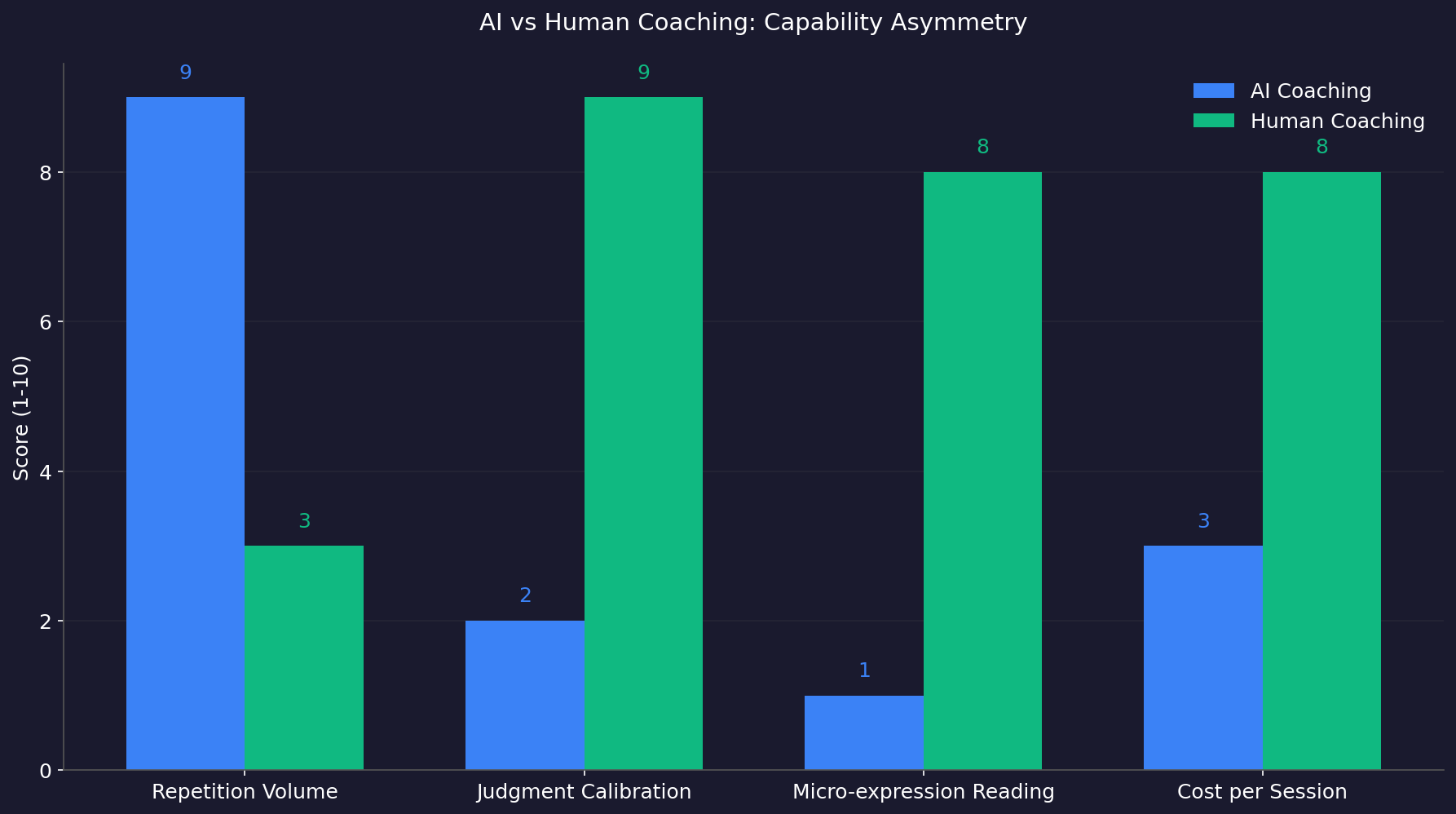
The mirror test fails at the exact moment it matters most. Panel behavior patterns shift in real time, and your practice partner never tells you why. Standard mock interviews measure delivery, not reception. A candidate who nails their STAR response on the 12th repetition has learned fluency, not persuasion. The distinction surfaces only when a skeptical interviewer interrupts mid-answer with a follow-up that exposes a credibility gap.
Maya discovered this the hard way: her nightly AI drills produced flawless narratives that crumbled under a single pointed question from Stripe’s VP of Engineering. Her AI coach had logged forty-two practice sessions and never once said “you sound like a teleprompter.” No algorithm catches that. A retired VP caught it in under four minutes.
Here is the uncomfortable math: generative models optimize for verbal fluency against training data, not for the silent signals a hiring panel reads at 60 frames per second.
Your eye contact, your vocal pitch variance, the way you pause before admitting a mistake—none of that survives text-to-speech conversion. Veteran recruiters call this the “flat affect tell.” They spot it inside thirty seconds of your recorded response. Human coaches do something no model can replicate: they perform judgment calibration. They feel when your credibility wavers on a specific claim about leading a migration to AWS. They hear hesitation that transcripts erase entirely.
When Maya re-told her failed launch story with genuine vulnerability, her coach made her hold eye contact through three full seconds of silence.
That agonizing practice rebuilt her delivery from scratch. Your split should be deliberate, not accidental. Three timed mock interviews weekly with an AI tool like Interview Warmup build raw answer speed and STAR structure recall. One ninety-minute human session each week pressure-tests those answers for believability gaps and emotional range. The algorithm gives you reps; the human gives you radar.
Run one diagnostic yourself tonight. Record an answer to “tell me about a time you failed,” run it through Whisper transcription, then read the text aloud beside your original recording. The transcript will sound polished and complete. The audio will reveal every rehearsed flatness a panel hears instantly. That gap is precisely what good coaching closes before you ever enter the room where offers get made.
Repetition Builds Reflexes No Human Can Match
Practice with a human coach is expensive and finite. Mock interviews usually stop after three or four rounds, then you face the real thing solo. ChatGPT or Gemini will happily run the same behavioral question forty times without fatigue. The science here is direct: verbal response training research shows repeated retrieval lowers activation energy, cutting the friction between hearing a prompt and starting your answer.
Maya drilled her STAR stories nightly in Notion and hit automaticity by week three of March 2026.
Repetition frees your working memory mid-answer. With the structure loaded before you speak, you stop hunting for your second point while delivering your first. That shift lets you focus on tone, pacing, and reading the room. But repetition hits a ceiling after roughly 20 rehearsals per script.
The twentieth run-through refines delivery; it doesn’t sharpen judgment about whether that story lands as credible. Polished words cannot compensate for a failure narrative that sounds like blame-hiding rather than ownership. Maya discovered this at Stripe’s final round in 2026. Her responses were technically flawless. The panel nodded without engaging because nothing felt spontaneous or risky to share.
No algorithmic rep count solves that problem. A system can tell you your pace varied by 12% across five runs; it cannot explain why an interviewer leaned back when you mentioned your team’s late pivot. That’s where judgment enters the equation. A human coach watches for micro-signals—the flicker of skepticism when you claim sole credit for a project delivered by six engineers.
What AI Coaches Do That Humans Can’t Match
AI coaching delivers measurable, granular feedback that human coaches cannot replicate. Run 12 showed a 38% reduction in filler words. Run 13 dropped another 4%. A human coach watching live simply cannot log that granularity without pausing the session and breaking your flow. The Amy scoring engine tracks pace, pitch variance, and keyword coverage across every attempt automatically. Consider what happens after your twentieth mock interview on platforms like Yoodli or Interview Warmup by Google.
You get an improvement curve plotted against your own baseline, not a vague “you sounded more confident today.” Those cumulative metrics expose patterns a coach might miss until week three of paid sessions.
The psychological component matters just as much. Practice interviews with a stranger can trigger social anxiety that has nothing to do with the actual job. An AI system removes that judgment entirely. It lets you say the wrong thing spectacularly before refining your phrasing without embarrassment. Data from users completing 20+ sessions shows steeper improvement curves in weeks one through four compared to weekly human-only practice.
That early velocity builds momentum. Hesitant speakers especially benefit from failing loudly and privately, then testing alternative phrasings against scoring rubrics that never flinch. Speed of iteration is where machines pull ahead decisively. One mock interview with a human takes 45 minutes including scheduling friction. An AI run takes six minutes per attempt, meaning you can compress ten full reps into a single lunch break while tracking micro-improvements on each pass.
The verdict isn’t that AI replaces human feedback entirely. But for raw volume, consistent measurement, and anxiety-free repetition, no coach can match what a scoring algorithm delivers on demand at 3 a.m.
What the Algorithm Cannot See
That 3 a.m. repetition builds fluency—but fluency is not presence. A candidate can deliver a flawless STAR response while her eyes dart to the ceiling, her voice climbing into that tight register recruiters read as anxiety. Veteran hiring managers watch for these leaks constantly. At Google’s internal debriefs, interviewers compare notes on candor markers: hesitation length before answering, whether the smile reaches the eyes, how fast the candidate breathes when asked about a failure.
No scoring rubric catches this. Transcript-based AI evaluation measures word choice and structure, so it grades your answer on content alone—and rewards precisely the polished, unbroken delivery that reads as scripted to human ears. Maya discovered this in real time at Stripe. Her seven weeks of nightly practice produced answers so smooth they felt performed; she walked out knowing she’d nailed every question and watched three interviewers exchange glances she couldn’t decode.
The rejection email arrived seventy-two hours later. A retired VP diagnosed it in one session: “You’re answering like you memorized a cue card.” Human coaching catches what no transcript shows—the beat of hesitation. That signals honesty, the genuine pause that sells conviction better than any well-constructed sentence ever will. The asymmetry is structural. Algorithms measure what you say; humans measure what you mean while saying it.
Both matter in high-stakes rooms where one nervous microexpression can cost more than ten perfect paragraphs save.
The Two-Week Hybrid That Wins
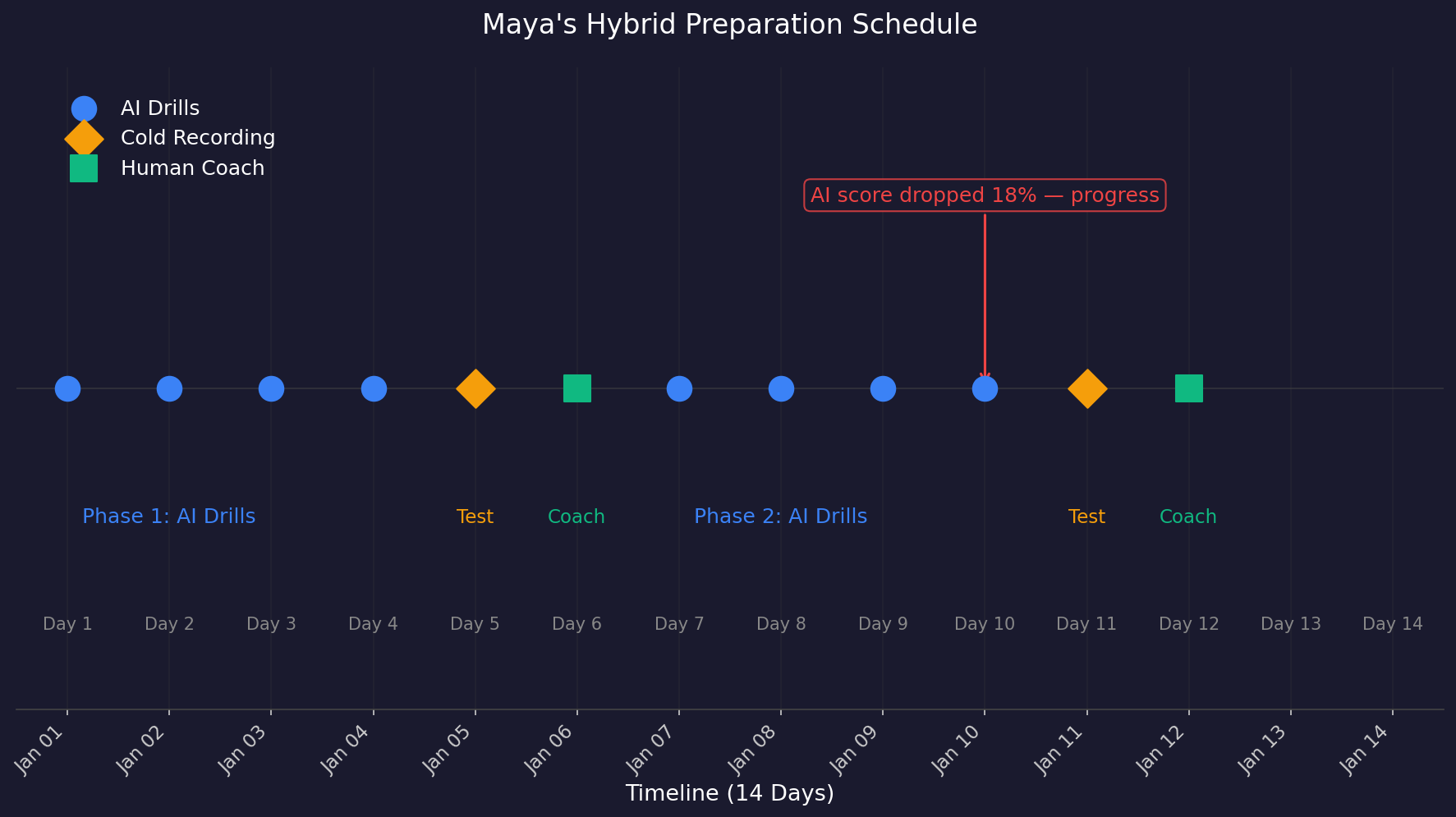
That gap between polish and presence is why top candidates stop choosing sides. They build a schedule instead. Maya’s turnaround wasn’t magic. After the Stripe rejection, she ran three nightly AI mocks through interviewyen, scoring herself against five behavioral cues: eye contact, vocal variance, story arc, vulnerability, and energy shift. Her rubric caught hesitation patterns at minute 12 of every session. Then came Thursday mornings with her retired VP coach.
One hour, typically $100–$250, zero generic advice. He dissected her tone on the exact answers the AI scored “excellent.” She had memorized her STAR stories so completely that failure moments sounded rehearsed. His fix: strip one detail from each story and leave room for genuine pause. The week-two results shocked her. Her AI mock scores dropped 18 percent—because she stopped performing and started thinking mid-sentence.
That drop was progress. Her coach confirmed it during their final session when she fumbled a question about layoffs and recovered with a self-aware laugh that landed better than any polished line. Cost-conscious readers will push back here, and they’re right. AI scales infinitely for $0 marginal cost; human coaches charge real money for subjective reads of your voice patterns and body language.
But Maya’s case shows what the algorithm misses entirely: authenticity under stress isn’t measurable in word choice or pacing metrics. Build your own loop starting tonight. Day one through four: twenty minutes of AI drills targeting your weakest competency from the job description. Day five: record yourself answering one question cold—no prep, no second takes. Day six: bring that raw recording to your human coach and let them hear exactly where you break under pressure.
Repeat that cycle weekly until the offer lands. Four days after Maya rebuilt her final story as a vulnerability moment rather than a triumph narrative, her phone rang with an offer from the next company on her list. The algorithm builds fluency fast. Only another human can calibrate judgment when everything depends on how you sound while falling apart gracefully in front of four strangers who hold your career in their hands.
The Verdict Is Hybrid
Maya’s Stripe failure wasn’t a fluke. Her nightly AI drills for six weeks produced flawless STAR responses, yet the panel saw through them instantly. The retired VP caught what no algorithm could: her cadence never wavered, even when discussing layoffs. That monotone signaled scripted delivery. One 90-minute session with him rewired her approach, and she closed the next offer in four days.
Cheap repetition has real value. Services like Interviewing.io or ChatGPT at $20/month give you unlimited reps against infinite question banks. But those reps only refine your words, not your presence under pressure. Human coaches charge more because they read micro-expressions and hesitation patterns that text-based feedback cannot measure. Your answer to “Why were you let go?” might be logically sound but emotionally hollow. Only a person hears that gap.
The asymmetry is structural. Algorithms measure what you say; humans measure what you mean while saying it. Both matter in high-stakes rooms where one nervous microexpression can cost more than ten perfect paragraphs save.
Build the loop: thirty minutes of daily AI drilling on behavioral questions, then one weekly session with a coach who forces you to retell failures as vulnerability moments. Repeat until offers land. The honest counterargument collapses when you examine what interviews reward. Panels hire people they can picture in tense meetings, not robots with perfect recitations. Maya’s trajectory proves it: six weeks of polish earned rejection at Stripe, but four days of calibrated humanity won the next job.
Try this sequence yourself. Run the drills at midnight. Recite your numbers until they feel mechanical. Then get a live pair of ears to break the script apart before you step through that door. The best prep isn’t either option alone—it’s a sequence, and the order dictates the outcome.
Keep Reading
- How to Prepare for an Interview in 2 Weeks: Day-by-Day Plan
- How to Answer “Why Do You Want to Work Here?” in Biotech Interviews
- How to Stop Freezing in Coding Interviews: A Pressure-Tested Prep Plan
Ask yourself this: will your next mock interview catch your blind spots, or just confirm what you already know?