When Someone Asks "Tell Me About Yourself," Say THIS (Not That)
Posted on August 23 2026 by Interview Zen TeamThe First 90 Seconds Rule: Stop Reciting a Biography
You walk in prepared. Your résumé is polished, your achievements are bullet-pointed, and you’ve rehearsed the arc of your career for the 47th time. Then they ask it: “Tell me about yourself.”
The most experienced hiring managers already know what’s on your résumé. They read it before you sat down. Asking you to recite it again isn’t a test of memory. It’s a test of judgment.
A candidate who reels off their job history verbatim signals they didn’t grasp what the question actually measures: can you filter signal from noise under pressure. This single prompt separates the contenders from the rest faster than any technical question. The trap is treating it like an autobiography. You get 90 seconds to answer, and every second wasted on “I graduated from X University” is a second you’re not building the case that this role needs you specifically.
Research shows interviewers form lasting first impressions within the first two minutes, and most candidates spend half that time telling them things they already know. Here’s what nobody tells you about that question. It’s not an invitation to summarize your past. It’s an audition for how you think on your feet, prioritize information, and connect dots between your experience and their problem.
The best answer doesn’t follow chronological order. It follows emotional logic: start with why this work matters to you now, then backfill only the experience that supports that narrative. There are exactly three structures that consistently convert that open-ended question into a hiring signal so strong it changes the trajectory of the conversation.
Below, I break down each one with word-for-word scripts, timing breakdowns per section, and one specific trap that kills even strong answers in under 15 seconds. Use any of these frameworks tomorrow morning, or keep throwing darts blindfolded in a room full of recruiters with stopwatches running silently behind their notebooks.
The opening of your answer sets the frame for everything that follows. Research on primacy bias shows interviewers form impressions within the first 30 seconds and spend the remaining interview time confirming those assumptions. Three things must happen in those first ninety seconds: establish relevance, demonstrate self-awareness, and create curiosity. If you’re telling a chronological story (“I grew up in Ohio then studied computer science at…”), you’ve already lost. The interviewer is thinking about lunch, not your senior design project.
A product manager interviewing at Shopify changed her opening from “I have eight years of experience managing SaaS products” to “I cut churn across two product lines by reframing how we measured engagement.” The second version works because it forces. A question: How? Structure matters more than content here.
Lead with impact, not history. Your most impressive achievement should open, even if it happened two jobs ago or six years back in time. Interviewers don’t process information linearly when evaluating fit; they anchor on whatever lands first emotionally or numerically. The trap most candidates fall into: assuming more detail equals better impression.
Recruiters hear this dozens of times per hiring cycle—after three “I was responsible for” statements, their attention drops below useful levels, and your relevance is destroyed before you reach your current role.
Let me give you a concrete example of the difference. A senior backend engineer interviewing at a fintech startup opened with: “I’ve spent the last four years keeping payment systems online during peak traffic events.” That’s it. No company name, no job title, no education. The interviewer leaned forward immediately because that sentence signals three things at once: domain expertise, operational maturity, and comfort with high-stakes environments.
Compare that to the candidate who opened with: “I studied computer science at Berkeley, then joined Oracle as a software engineer. And after two years I moved to a startup called…” By the time that candidate reached their actual relevant experience, the interviewer had already mentally categorized them as “another resume reader.”
The fix is brutal simplicity. Write down your single most impressive measurable outcome from the last three years. Now write the sentence that leads with that outcome, stripped of all context. That’s your opening. Context comes later, only if they ask.
Build Your Three-Minute Narrative Arc: The 45-Second Savings Doesn’t Come for Free
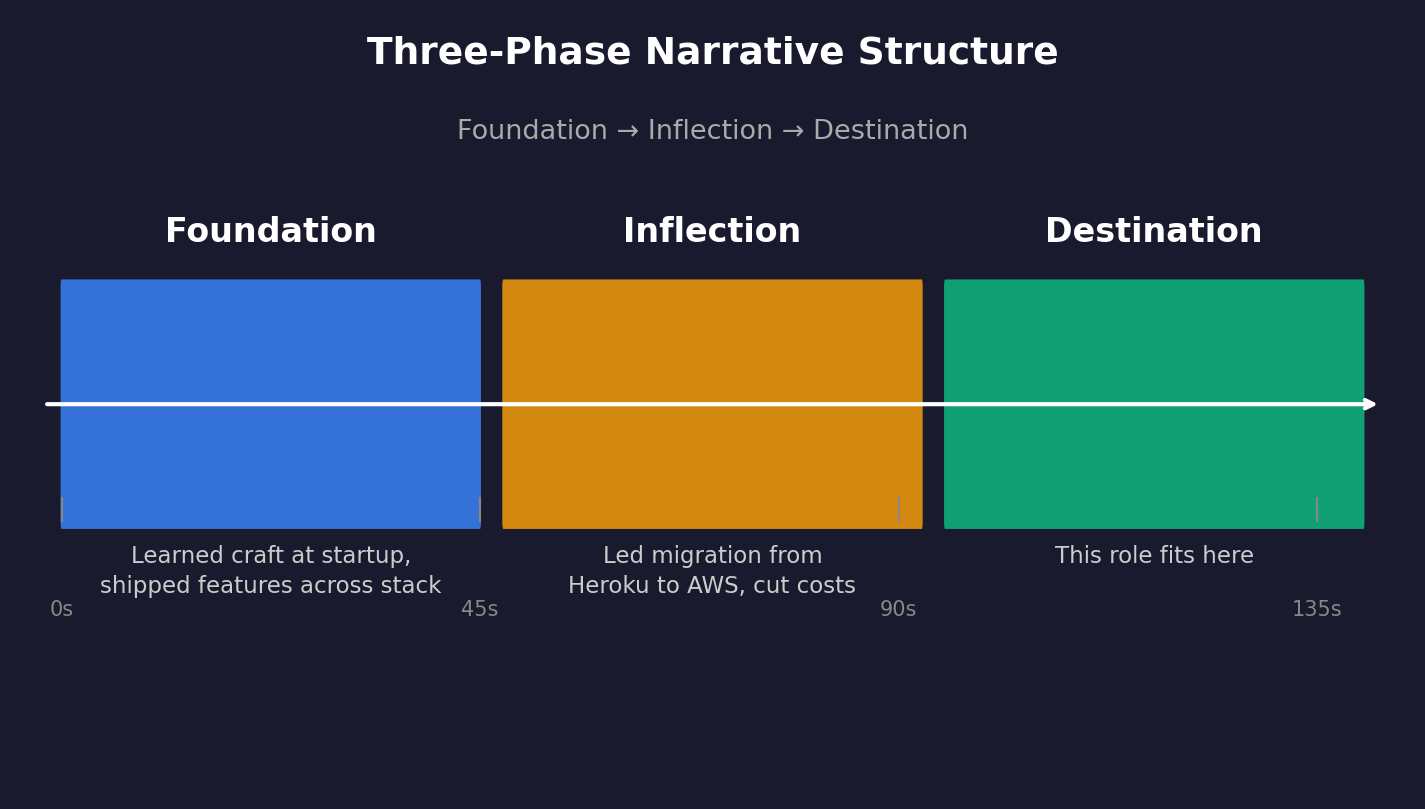
Each phase gets exactly 45 seconds when spoken naturally. Prep a single Google Doc with bullet points per phase. List the project names, the team size, the measurable outcome. Write “reduced query latency from 800ms to 90ms,” not “improved performance.” Practice against a stopwatch until each section lands consistently under a minute. One common mistake kills this approach instantly: cramming every job you’ve held into all three phases.
Nobody needs your college internship unless that’s where you discovered your specialization. Cut anything older than five years or unrelated to the role’s core responsibilities.
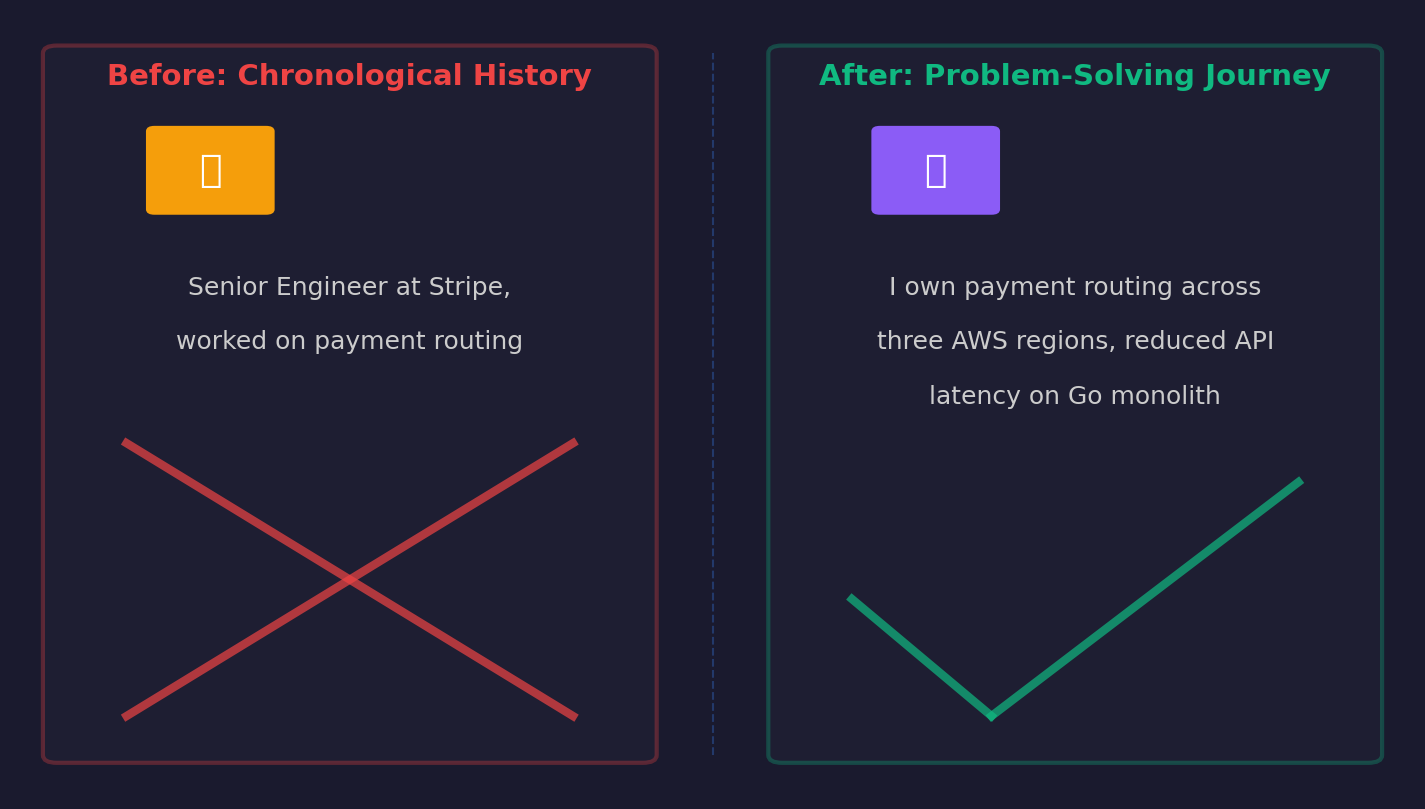
Your current role becomes context, not the headline. Instead of “Senior Engineer at Stripe,” try: “I own payment routing across three AWS regions.” That single sentence tells an interviewer everything they need to know about scope, scale, and technical competence. The company name is garnish; the throughput figure is the meal. Map your resume backward through this lens before every interview. Ask yourself: did my last project save money, speed something up, or unblock another team?
If it did neither, it belongs in a skills list, not your opening statement.
One caution here: specificity without proof sounds like exaggeration. Your “15% revenue lift” needs a concrete mechanism. Was it an A/B test on checkout flows? Was it a database indexing strategy that shaved query time? Vague outcomes read as fiction; specific engineering decisions read as experience.
This shift from history teller to problem solver rewrites how interviewers frame you mentally. They stop evaluating whether you’re qualified and start imagining whether they’d survive their incident response rotation beside you.
#
The Foundation Phase: Why You Started
The first 45 seconds should answer one question: what drew you to this work in the first place? Not your childhood dream, not your college major, but the specific moment you realized this craft mattered to you. A data scientist I coached opened with: “I got hooked on analytics when I realized a single dashboard change could redirect a million dollars in marketing spend.” That’s foundation. It tells the interviewer you have intrinsic motivation, not just a paycheck drive.
Skip the “I’ve always loved technology” cliché. Everyone says that. Instead, name the specific problem that hooked you. Was it debugging a memory leak at 2 AM? Was it watching a poorly designed form lose customers? That moment of recognition is your foundation, and it takes exactly one sentence to deliver.
#
The Inflection Phase: Where You Leveled Up
The second 45 seconds covers the transition that changed how you work. This is where you mention the promotion, the failed project that taught you something, or the move from individual contributor to team lead. The key is framing it as a capability shift, not a title change. “I moved from writing code to designing systems” beats “I got promoted to senior engineer” every time.
A platform engineer I worked with used this phase to describe his move from on-call firefighting to building self-healing infrastructure. He said: “After two years of pager alerts at 3 AM, I realized I was treating symptoms, not causes. So I spent a quarter building automated rollback tooling that cut our incident rate by 60%.” That’s an inflection point that shows growth, judgment, and initiative in under 20 seconds.
#
The Destination Phase: Where You’re Going
The final 45 seconds connects your trajectory to the role you’re interviewing for. This is where you explicitly state why this company, this team, this problem. “I want to take that same reliability playbook and apply it to your edge compute infrastructure” is a destination. “I’m looking for a new challenge” is a placeholder.
The trap here is vagueness. “I’m excited about your company’s mission” means nothing. Instead, reference something specific from your research: their recent funding round, their open-source repo, their public postmortem. Show you’ve done homework and you’re not just spraying resumes at every posting.
Use Their Language, Not Yours: Skim the Job Description Before Your Interview
Pull out their exact pain vocabulary. If they wrote “incident response maturity,” use those three words in your answer verbatim. You’re proving you read their requirements and mapped your experience onto their specific failure modes rather than reciting a resume script. The words matter as much as the work itself does.
Here is how this works in practice. A candidate interviewing for a site reliability role at a logistics company found the phrase “predictive failure detection” buried in the job description. She opened her answer with: “I’ve spent the last three years building predictive failure detection for a fleet of 40,000 IoT devices.” The interviewer visibly perked up because she used their exact terminology. She wasn’t just qualified; she was speaking their language.
The reverse also applies. If the job description emphasizes “cost optimization” and you keep saying “efficiency improvements,” you’re creating friction. The interviewer has to translate your words into their framework, and that mental overhead costs you attention. Mirror their vocabulary and you eliminate that friction entirely.
#
The Outcome-First Framer vs. The Chronological Storyteller
The outcome-first framer opens with impact: “I’ve spent the last five years cutting infrastructure costs across high-scale platforms.” That single sentence lands before any job titles or timelines.
The chronological storyteller, by contrast, starts with “At Amazon I worked on EC2 billing” and loses the listener before reaching the relevant work.
Think about what a hiring manager actually hears. A chronological storyteller sounds like: “At Amazon I worked on EC2 billing.” Then they add: “After that I joined Stripe’s payments team.” Each transition resets the listener’s attention. The outcome-first framer takes a different approach. “I’ve spent the last six years reducing serverless cold start latency across three platforms.” One story arc replaces three disconnected resumes.
This pattern emerged from analyzing failed phone screen recordings. Candidates with identical skill profiles produced radically different outcomes based solely on narrative structure. Hiring managers mentally tab out during chronological recitations by the third bullet point. You have roughly 45 seconds before their attention drifts elsewhere. Their focus moves toward Slack notifications or tomorrow’s standup agenda instead of your story.
Build your story arc before your bullet points arrive at the interview window. Map each role change as a problem-chapter, not an employer hop. Chapter 1 was reliability engineering under pager stress. Chapter 2 focused on scaling infrastructure for growth surge cycles. Chapter 3 built tooling to eliminate the firefighting pattern entirely. When you frame your career as chapters of problem-solving, you own the narrative completely. You stop letting HR write it for you based on LinkedIn entries alone.
Common Mistakes That Kill Strong Answers in Under 15 Seconds
Even with the right structure, a single misstep can undo everything. Here are the four most common execution errors I’ve seen in hundreds of mock interviews.
Mistake #1: The Apology Opening. “I know my background is a bit scattered, but…” or “I’m not sure if this is exactly what you’re looking for, but…” This instantly signals low confidence and primes the interviewer to look for gaps. Never apologize in your opening. If you have a career gap or a pivot, own it with confidence later in the conversation, not as a preemptive disclaimer.
Mistake #2: The Data Dump. Listing every metric from every role without narrative glue. “I improved efficiency by 15%, then I cut costs by 20%, then I reduced churn by 10%.” Numbers without context are noise. Each metric needs a problem it solved and a decision you made. Otherwise, you sound like a spreadsheet reading itself.
Mistake #3: The Name-Drop. “I worked directly with the CTO” or “I was on the CEO’s special projects team.” Unless that relationship directly relates to the role you’re interviewing for, it reads as status-seeking, not competence. Interviewers care about what you did, not who you stood next to.
Mistake #4: The Rambling Close. Ending without a clear transition to the interviewer’s next question. Your final sentence should hand the conversation back: “That’s the short version of how I got here. I’d love to dig into the specifics of how I’d approach your current infrastructure challenges.” This signals you’re aware of the conversational flow and you’re not going to monologue indefinitely.
Practice Changes Everything: Theory Collapses Without Reps
You can memorize every reframe and still freeze when the hiring manager asks about your two-year career gap. The difference between polished and defensive is muscle memory. Each practice run shaves hesitation by seconds, rewiring your instinct to explain rather than apologize. After five mocks, most candidates stop saying “unfortunately” and start saying “deliberately.”
That gatekeeping makes experienced interviewers hyper-aware of who can defend their decisions under scrutiny, not just parrot frameworks. Run through the Chapter Narrative exercise aloud three times minimum. Record yourself on Zoom’s built-in transcriber or use QuickTime audio capture. Listen for filler words: “like,” “actually,” “honestly.” Each one signals uncertainty to trained ears. Pair with a peer from a different industry for cross-pollination.
Here’s a specific drill that works. Set a timer for 90 seconds. Answer the question out loud with no notes. Transcribe the recording. Now go through the transcript and highlight every sentence that doesn’t serve one of three purposes: establishing relevance, demonstrating self-awareness, or creating curiosity. Cut those sentences. Re-record with the trimmed version. You’ll be shocked how much dead weight you were carrying.
A second drill: record yourself answering the question, then listen to it at 1.5x speed. The faster playback reveals verbal tics and pacing issues you miss at normal speed. You’ll hear where you rush, where you drag, and where you lose energy. Fix those spots specifically.
The question isn’t what you’ve done. It’s whether you know what matters. Every minute spent listing credentials is a minute you’re not proving fit. The best candidates skip the biography entirely and jump straight to their problem-solving narrative. They treat those 90 seconds like a thesis defense, not a reading of their résumé.
Keep Reading
- How to Prepare for Machine Learning Interviews – Step-by-Step Roa…
- Stealth Mode Career Growth: Crush Interview Prep While Working Full…
- How to Answer “Why Do You Want to Work Here?” in Biotech Interviews
So next time someone asks about you, pause before speaking. Ask yourself: does this detail move the interview forward? If it doesn’t, cut it. Your why, your pattern recognition, your specific value—that’s what will separate you from the other candidates who recited their job history word for word. That single choice changes everything.